








How to Choose an Electric Skillet: Space, Controls and Cleaning
Many people buy an electric skillet as an extra pair of hands when the stovetop is full, or for a kitchen without an open flame. Once they start using it, they discover that it is more than a frying pan with a plug. With its own thermostat, a reasonably deep pan and a fitted lid, it can cook eggs in the morning, sear a few steaks at lunch and simmer dinner in the evening. The finished dish can go straight to the table in the pan. One appliance can take on much of the everyday work of both a frying pan and a saucepan.
That versatility also means products vary considerably. Some heat evenly across the cooking surface; others scorch food at the edges before the center is ready. Some pans can be immersed once the thermostat is removed, while others have seams that trap residue and make every cleanup a chore. Rather than memorizing rankings, work through how you cook, the space you have, the controls and the cleaning design. This guide follows that decision process: space and pan shape, temperature control and heat performance, cleaning and care, and a buying checklist. We then apply the checklist to our JG-002D.
1. Space and pan shape
1.1 Start with what you cook
An electric skillet is unlikely to excel at every cooking method, because each method asks something different of the appliance. List the dishes you actually make, then use the table below to narrow your options. It is a more useful starting point than brand or price.
| Main use | Suitable design | What to check |
|---|---|---|
| Breakfast foods and small portions of sautéed food | A shallow pan with a wide opening | Inside dimensions and even heating |
| Stews and one-pan meals | Sides around 5 cm deep and a fitted lid | Capacity, lid fit and stability at lower settings |
| Deep-frying on the countertop | Deep sides and a broad temperature range | Maximum temperature, permitted oil levels and heat recovery |
| Low-temperature cooking and extended warming | Fine temperature adjustment and stable low-temperature operation | What the lowest setting means and how much the temperature fluctuates |
| Serving straight from the pan | A keep-warm setting and a lid | Actual warming temperature and lid fit |
If you mainly cook eggs, pancakes or burgers—foods that need room to lie flat and be turned—a wide, shallow pan is easier to work with. For frequent stews, one-pan dinners or deep-frying, look for deeper sides and a well-fitting lid. Decide whether you fry more than you simmer, or simmer more than you fry, before choosing the depth.
1.2 Usable cooking area is smaller than the advertised size
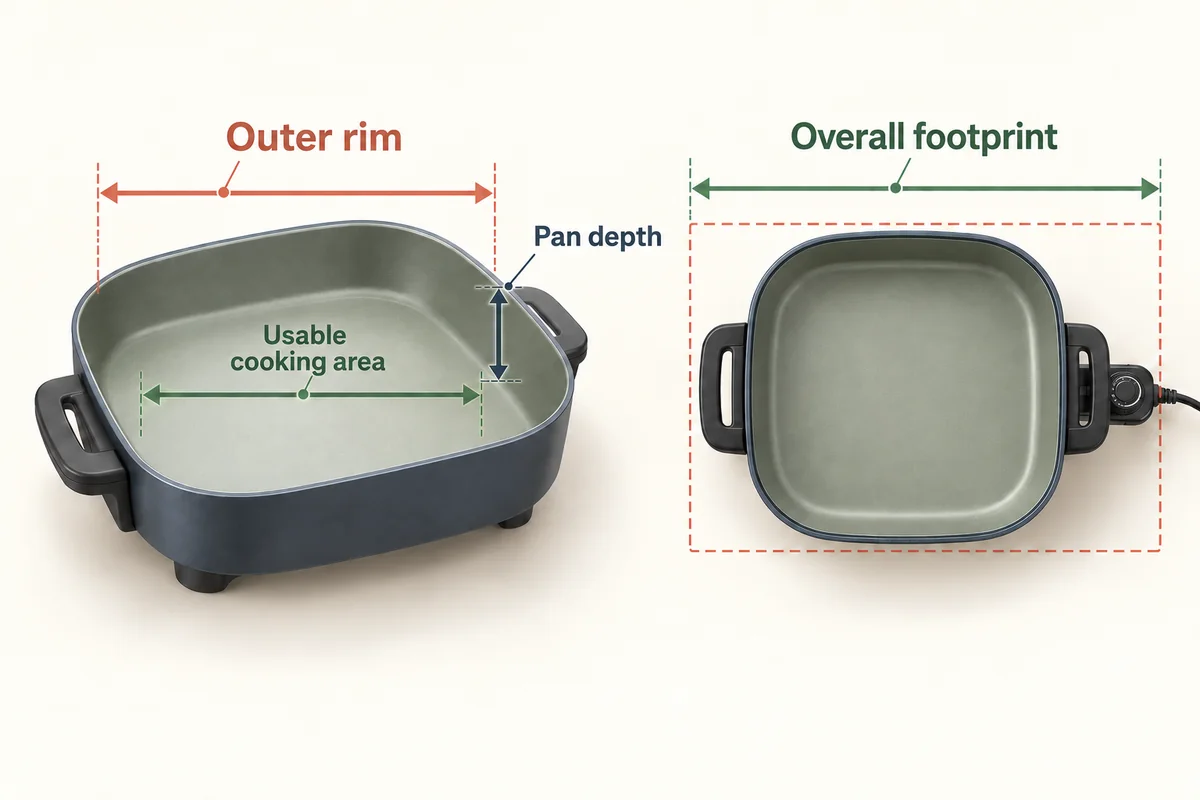
A size such as “12 inches” or “30 cm” on the box usually refers to the outer rim, not the flat cooking surface. In comparisons of several popular models, independent reviewers recorded a usable base of roughly 13.75 × 9.75 inches in a pan advertised as 16 × 13 inches. A nominal 12-inch model might offer only about 10 × 8 inches of flat cooking space. The usable cooking area can be more than 30% smaller than the advertised size suggests.
Ask for the inside dimensions at the rim, the length and width of the flat cooking surface, and the pan depth. Sketch the usable area on paper to see how much food will fit in a single layer. That tells you more than the number on the box.
Shape also affects how much food fits into the space available. A square pan makes better use of its corners and sits neatly near a counter corner or cabinet edge. When a square’s side length equals a circle’s diameter, its theoretical base area is about a quarter larger; rounded corners and the pan walls reduce the usable area in practice. Those curved corner transitions can also be harder to scrape clean. A round pan is easier to stir, although the space around its perimeter is less useful for arranging food. A rectangular pan suits a whole fish or a layout with meat on one side and vegetables on the other.
1.3 Pan depth sets the limits—and the tradeoffs
Depth is the key difference between an electric skillet and a shallow electric griddle. It determines which cooking tasks the appliance can handle:
- Electric griddle: Typically less than 2 cm deep, suited to grilling without added liquid and breakfast foods made from batter.
- Electric skillet: Usually 5–8 cm deep. The sides help contain splashes when frying and provide room for stock, sauces and vegetables, making dishes such as braised ribs, sukiyaki, pot roast and curry less likely to spill over.
Deeper is not always better. Sides around 5 cm high leave room for simmering and frying, but very tall sides can get in the way of a spatula and encourage moisture to fall back into the pan, making a crisp crust harder to achieve. Low sides make turning food easier and let steam escape quickly, at the cost of liquid capacity and less room to contain a simmering dish.
1.4 Measure the complete footprint and storage space
Whether a skillet can stay on the counter depends on the space it occupies when fully assembled, rather than the pan dimensions alone. Include both heat-resistant handles, which often project 3–5 cm, the removable thermostat, the lid knob and any steam vent. Leave the clearance specified in the manual for ventilation and safe operation, keep the appliance away from tight wall spaces and walkways, and check the outlet location before buying.
Cord length is easy to overlook. Independent reviews recorded original cords ranging from 27.5 to 36 inches—a difference of just over 20 cm. A short cord limits the appliance to a position close to an outlet and can make tableside cooking difficult. A longer cord needs to be bundled separately for storage.
Storage can limit your choice of size. A removable base separates the pan from its heating assembly, while a folding base can tuck its supports into the pan. Both can reduce storage height substantially, which helps in a kitchen with limited cabinet space. More moving parts also mean more details to check: does the base lock securely, do the handles wobble, and could the release button be pressed accidentally while wearing oven gloves? Weight matters too. Similar products range from 3.5 lb to nearly 10 lb, or about 1.6–4.5 kg, which affects whether you can lift the appliance with one hand. A lid that stacks or hangs and a thermostat that stores separately can make the difference between putting the skillet away and leaving it on the counter.
2. Temperature control and heat performance
What an electric skillet adds to an ordinary pan on a gas burner is an adjustable thermostat. Uneven cooking, pancakes that burn outside while staying undercooked inside, and stews that boil dry often point to inaccurate control or uneven heat distribution, rather than a lack of power.
2.1 Built-in dial or removable thermostat
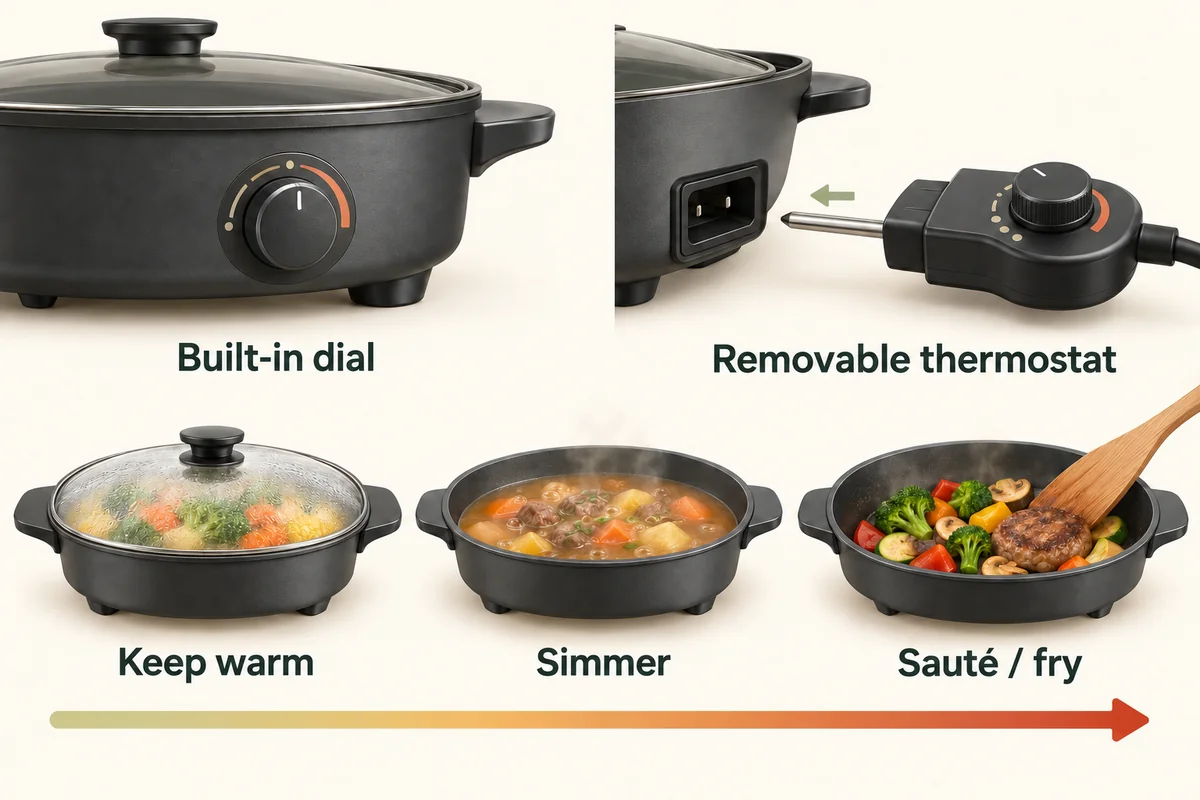
Two control designs are common. One has a dial mounted directly on the handle or body; the other uses a removable probe thermostat that plugs into the side of the pan. The removable design makes it easier to separate the controller from the pan. Temperature accuracy and whether the pan can be immersed must still be confirmed separately for the particular model.
The probe socket is a key cleaning and sealing detail. Ask how it is sealed, whether the thermostat is easy to insert and remove, and whether it stays firmly connected. Reviewers have found samples that lose power after a slight bump because the connection is loose. For use at the table, a magnetic breakaway cord offers a safer arrangement: an accidental pull disconnects the cord rather than dragging the whole appliance off the table.
2.2 Temperature range and settings
A well-designed skillet should offer clearly defined temperature settings. Setting names and temperature ranges vary by model. Use the table below to understand their purpose, then confirm the actual range in the manual and through sample measurements:
| Setting | Temperature check | Purpose |
|---|---|---|
| Keep warm | Confirm the actual holding temperature and fluctuations; do not infer them from a minimum frying setting of 200°F, about 93°C | Keep cooked food warm without a continuous boil that evaporates too much liquid |
| Simmer | Adjust as instructed in the manual, watching for a steady, gentle simmer | Cook meat slowly until tender and allow flavors to develop |
| Sauté / fry | A cooking-surface temperature of roughly 160–200°C is a reference range; the dish and appliance determine the setting | Quickly cook vegetables and brown sliced meat to bring out its flavor |
Many models list a maximum temperature of around 230°C, or about 450°F, with the middle of the range covering everyday frying and simmering. Whether the appliance can reach and hold its stated maximum depends on the model.
2.3 Accuracy and stability matter more than the maximum
Temperature performance tells you more than the highest number on the dial. Ask about three things.
The difference between the setting and the actual temperature. Mechanical thermostats commonly overshoot. Independent reviews recorded several samples running 50–90°F above the selected temperature at higher settings. Experience can help compensate for an offset if it is consistent. If the difference changes unpredictably between settings, experience is much less useful.
The difference between the center and the edges. In the same comparison, better-performing models showed a center-to-edge difference of 20–30°F; less even models reached 40–60°F. A larger difference means moving food around more often, and can leave pancakes from the same batch with very different browning.
Stability at low temperatures. Many products have a minimum temperature setting near 200°F, about 93°C, while low-temperature cooking typically calls for a steady temperature around 140°F, about 60°C. Some reviewed models fluctuated by more than 35°F near their lowest setting, making them unsuitable for that task. A stew needs a gentle simmer maintained over time, rather than repeated bursts of boiling followed by pauses.
2.4 Pan thickness and heat retention
Even heating is one of the biggest differences between electric skillets. The arrangement of the heating element beneath the pan and the thickness of the pan affect the temperature difference between the center and the edges. Most pans use cast aluminum or formed sheet metal, with thickness influencing how well they retain heat. A very thin stamped aluminum base can develop hot spots above the element while the edges stay cooler. A cast aluminum alloy pan of suitable thickness balances heat storage and conduction more effectively, so adding chilled meat causes a smaller temperature drop and the pan recovers faster, helping meat brown well while staying tender.
A simple way to assess this is to cook a batch of pancakes across the full surface and compare their browning. You can do it when evaluating a supplier’s sample, and it is more revealing than the specification sheet alone.
2.5 Power and the electrical circuit
Electric skillets commonly have rated power between 1000 W and 1500 W, with larger models for group meals reaching 1800 W. Higher power supports faster heat recovery and repeated batches. A well-designed, lower-power pan can still work well for everyday small portions. At home, also check the circuit capacity: running a power strip at its limit for long periods is unsafe.
3. Cleaning and care
Even a versatile appliance can end up unused in a cabinet if cleaning it is a chore. Ease of cleaning comes from the design, rather than the marketing copy.
3.1 Removing the thermostat does not make every pan immersible
Unplug the appliance and let the pan cool before cleaning. If it has a removable controller, detach it as instructed in the manual. Never immerse the controller or cord in water.
A removable thermostat does not automatically mean the whole pan can be immersed. That depends on the waterproofing of the pan and socket, and the manufacturer’s instructions. If the manual expressly permits immersion, use mild dish detergent and a soft cloth as directed. Appliances with integrated electrical parts, or without an explicit immersion allowance, should be wiped clean according to the manual. Check two further points: permission to immerse does not imply dishwasher compatibility, and the socket must be completely dry before the next use. Where seals are fitted, inspect their condition as instructed; leaking oil residue affects both hygiene and electrical safety.
3.2 Coatings and utensils
Nonstick coatings are common on electric skillets. A good coating suitable for food contact can reduce the amount of cooking oil needed, help eggs and fish release, and make cleanup easier with warm water and a sponge. Avoid steel wool and metal spatulas; wooden or silicone utensils help slow wear.
Surface texture changes the experience as well. A smooth surface gives food more complete contact for searing, but it may be harder to slide a spatula underneath. A finely textured surface can make stirring and turning easier, yet reduces contact with the food and can affect browning. It also tends to trap residue and may need repeated circular wiping. Favor a smooth surface if searing is your main use, and consider a textured one if you mostly stir-fry. The coating system and its durability depend on the materials, so treat them as a separate item to confirm with the supplier.
3.3 Look for places where residue collects
Rims and joints are common trouble spots. A pan formed in one piece is easier to clean than one assembled from several sections. The screws, seam depth and tight corners where handles and lid knobs meet the pan or lid all affect how easily you can wipe the appliance down. Smooth, rounded transitions are easier to reach. A lid that can be removed for washing and a steam vent without awkward crevices also simplify daily care.
A complex base that cannot be detached adds to the cleaning work. Keep water out of the base. If water enters accidentally, follow the manual’s instructions rather than reconnecting the appliance immediately.
3.4 Check three things in the manual
Before buying, find the manual and confirm whether the pan can be immersed or must be wiped clean, whether the base and thermostat must be kept entirely away from water, and whether dishwasher use is explicitly permitted. Unplugging the appliance and allowing it to cool before cleaning also helps slow wear on coatings and seals.
4. A practical buying checklist
4.1 Match the appliance to the household and setting
Use your usual number of diners and cooking setup to narrow the options:
| Consideration | 1–2 people / compact counter | Family of 3–4 | 5 or more / entertaining with several dishes |
|---|---|---|---|
| Suggested shape and size | Compact square, 20–24 cm per side | Standard square or rectangular pan, 28–32 cm per side | Large rectangular pan, with a long side of at least 35 cm |
| Depth | 6–7 cm for frying and small stews | 7–8 cm for a whole chicken or a larger batch of ribs | At least 8 cm for hot pot with several ingredients and group meals |
| Power | 1000–1200 W | 1300–1500 W | 1500–1800 W |
| Storage | A small footprint, with upright storage or a fit in a sideboard | Flat storage on a middle cabinet shelf | A dedicated storage space |
Common pan sizes range from compact square models around 20 cm to rectangular pans around 30 × 38 cm. The figures above are a starting point; confirm the actual inside dimensions and usable cooking surface. Whether a model can be stored upright, hold a whole chicken or be used for hot pot also depends on the product and your menu.
4.2 What to confirm with the supplier
Use this table to bring the earlier considerations together when comparing samples or requesting a quote:
| Item | Questions to resolve |
|---|---|
| Pan opening and depth | Usable cooking area, length × width; pan depth; whether the interior has dividers |
| Complete appliance dimensions | Length, width and height including handles, thermostat and lid knob; packaging dimensions |
| Electrical specifications | Rated power, voltage, plug type and cord length |
| Controls | Built-in dial or removable thermostat, temperature range, keep-warm setting and indicator lights |
| Lid | Material, domed or flat shape, steam vent design and whether it is included |
| Coating and base material | Coating system, base material thickness and permitted utensils |
| Cleaning | Whether the thermostat is removable, whether the pan can be immersed, and the list of detachable parts |
| Heat performance data | Heating curves with and without a cooking load; center-to-edge surface temperature differences |
| Construction details | Handle design, feet, and how the pan connects to the base |
| Included documentation and accessories | Manual languages, certification markings, accessories and packaging format |
For measured performance data, ask the supplier to state the test conditions, including ambient temperature, load and measurement positions. Results obtained under different conditions are not directly comparable.
5. From checklist to product: Hebang JG-002D
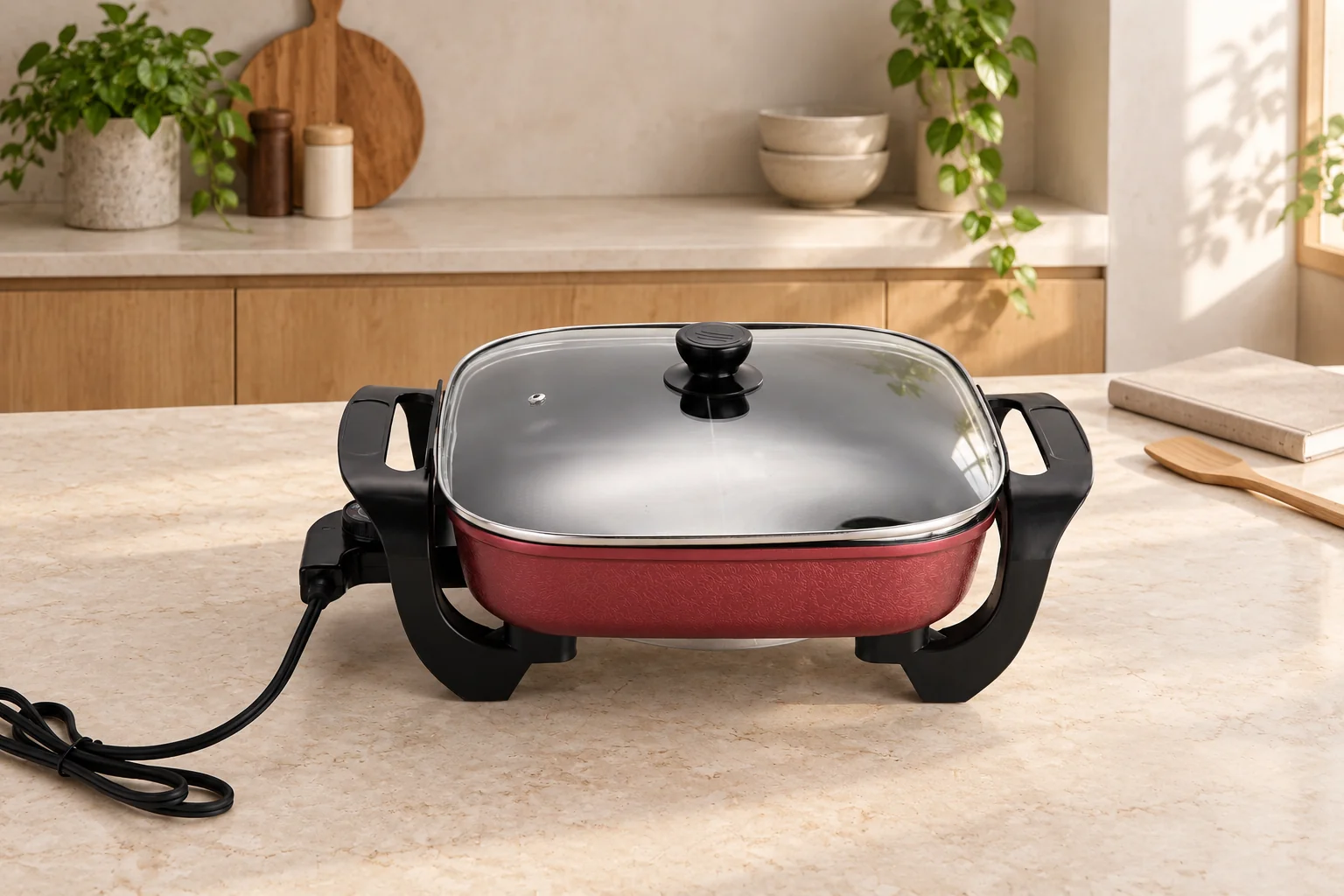
Apply this checklist to our JG-002D (Textured Red Square Electric Skillet), and you will find a practical design with a straightforward layout:
- 30 × 30 cm cooking chamber without dividers: A single, flat heated surface leaves the cooking area open for arranging and turning food. It suits everyday meat, pancakes and batch cooking for a household of three to four.
- A practical 6.5 cm pan depth: The pan accommodates frying and medium-sized stews, helping contain oil splashes while leaving room for sauces and stock.
- Clear lid with a black knob: Check the food and the reduction of sauces through the lid, with fewer interruptions during simmering to help retain heat and moisture.
- Textured red body and raised feet: The visible texture gives the appliance a distinctive presence on the table. Symmetrical side handles provide a secure grip for lifting, while the raised base leaves a gap between the hot pan and the countertop.
- 1500 W with a side-mounted temperature dial: The probe thermostat plugs into the side of the pan, keeping adjustment and settings easy to see. We can customize voltage and plug configurations for 120 V markets such as North America and 220–240 V markets, including European and Chinese specifications.
The JG-002D has a simple set of components, and removing the side-mounted thermostat makes the pan easier to clean and care for. If your menu calls for a larger surface for flat grilling, explore our electric griddle range. For grilling and hot pot at the same time, look at our grill-and-hot-pot combinations.
For kitchen appliance brands, importers and cross-border retail sourcing teams, we can develop OEM/ODM options around the JG-002D’s electrical configuration, body finish, nonstick coating system and printed retail packaging. Share your target market and project requirements with us; the available customization is confirmed for each project.
Browse our electric skillet range. For detailed JG-002D engineering drawings, packing specifications or a sample evaluation, contact the Hebang team.
Conclusion
Choosing an electric skillet comes down to four steps: list the dishes you actually cook, check the usable cooking area and pan depth, confirm temperature accuracy and low-setting performance, then decide whether the cleaning instructions suit you. The advertised size and wattage—the most visible numbers on the specification sheet—come later. Follow this order and you are much more likely to choose a pan that fits your kitchen.